Dancing in Primary Colours: A Cross-Curricular Movement Lesson inspired by Mondrian’s Composition with Red, Yellow, and Blue
Learning outcomes
Learners will:
1. Begin to recognise key characteristics of Piet Mondrian's artistic practice.
2. Develop an introductory understanding of Neo-Plasticism and its emphasis on abstraction, horizontal and vertical lines, and primary colours.
3. Explore how visual composition, spatial boundaries and creative constraints can inform movement improvisation.
National Curriculum links
Art and Design, Key Stage 2 — Pupils should be taught about great artists, architects and designers in history.
Physical Education, Key Stage 2 — Pupils should be taught to perform dances using a range of movement patterns.
Before the lesson
You will need:
Primary-coloured paints or other art materials
Paper or card
Masking tape or other suitable materials for marking out the space
Key vocabulary
Neo-Plasticism, abstraction, composition, boundaries, improvisation
Suggested additional reading
Burrows, J. A Choreographer’s Handbook. Routledge, 2010.
Mondrian, P. ‘Neo-Plasticism in Pictorial Art’. De Stijl, 1917.
Further inspiration
Another movement resource using Mondrian’s work as a basis for movement practice is Mondrian’s Grid, published in the BBC School Radio Dance Workshop, Autumn 2012 edition.
Prelude
Provide learners with primary colours (this can be any medium) and appropriate paper. Ask them to experiment with the colours for 5 minutes. The only rules are that they may use primary colours and create only straight lines and shapes made from straight lines.
Exposition
Show the learners the two following works by Mondrian:
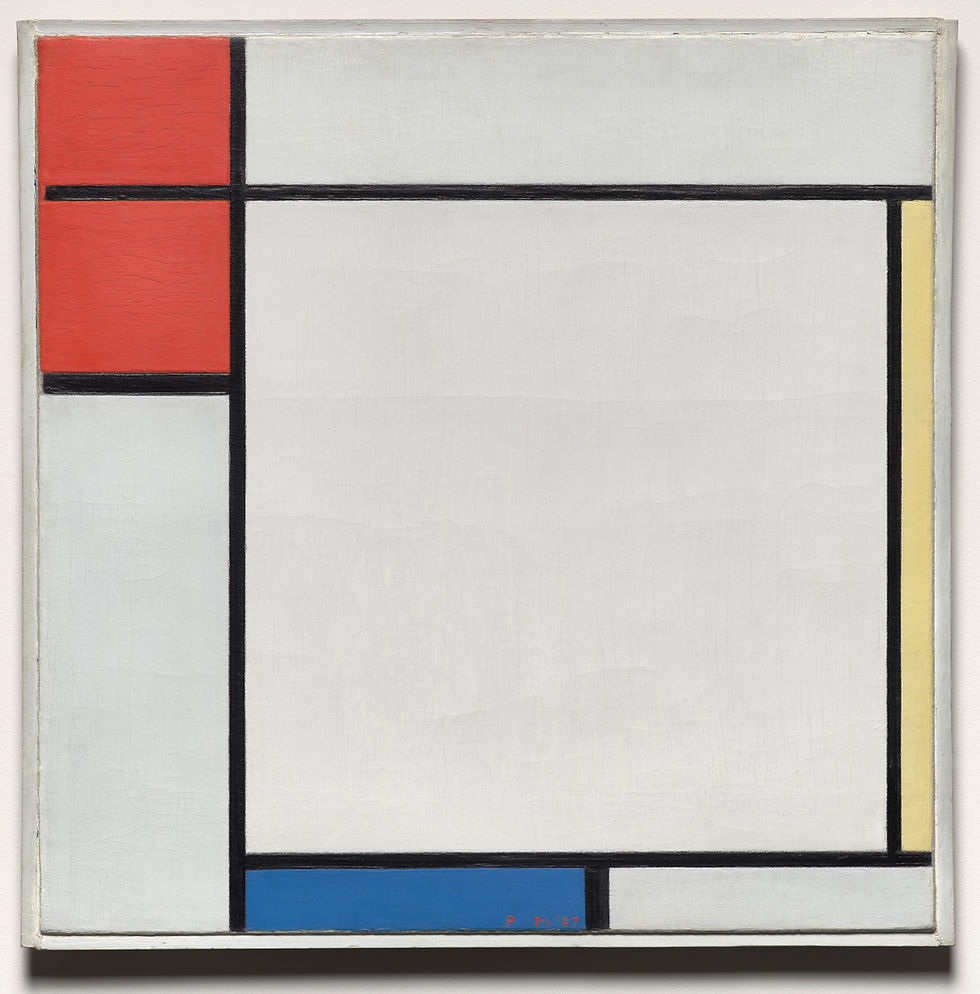

Piet Mondrian, Composition with Red, Yellow, and Blue (1927). Image courtesy of the Cleveland Museum of Art.
Piet Mondrian, Field with Young Trees in the Foreground (c. 1907).
Say to students:
These two images are very different. Can you guess or figure out what is the link between them?
After discussion, tell the students that both works were created by Piet Mondrian (1872-1944) and that as an artist his artistic practice and philosophy evolved considerably throughout his life.
Look at the images again. Ask learners:
What do you notice about how Mondrian uses the boundaries of the image?
How does he position lines, shapes and forms in relation to these edges?
Although these paintings are very different, both invite us to consider how an artist organises a composition within the boundaries of a picture.
Mondrian developed an artistic philosophy known as Neo-Plasticism, which sought to express universal harmony through abstract relationships between forms, lines and colours. In works such as Composition with Red, Yellow, and Blue, he explored how horizontal and vertical lines, rectangular forms and primary colours could be carefully arranged to create balance and harmony. He outlined his philosophy in ‘Neo-Plasticism in Pictorial Art’, published in De Stijl in 1917.
Development
Move into a space suitable for movement practice, and conduct appropriate health and safety checks of the space.
Facilitate a movement warm-up (you can find many in our resource bank!)
Explain that you are going to use Composition with Red, Yellow, and Blue as an improvisational score, with rules assigned to each subdivided area of the space. An improvisational score is a set of instructions or constraints that performers use to generate movement in the moment, rather than following a fixed sequence of choreography. With the learners, divide the space with masking tape or another suitable material which will clearly demarcate the space and not cause tripping hazards, to match the division of the space in Mondrian’s work.
At this point, clearly assign and model the colour-based rules for each subdivided area. For example, in red areas all movement has to originate from the left shoulder, in yellow areas all limbs must stay connected to the floor when moving.
Draw learners’ attention to how they might navigate transitioning between different areas of the space and how the arrangement of areas influences where dancers move and how they distribute themselves.
From this point onwards, use your professional judgement as a facilitator to shape the exercise.
Here are some top tips and considerations to have in mind when facilitating movement activities:
Number of participants in the space
Think about how many learners should be active in the entire space and subdivided areas at one time.
We recommend conducting this exercise in smaller groups rather than having all learners navigate the space simultaneously, as this can increase the risk of collisions and other accidents.
Here is an example of rule establishment:
There must be a minimum of 3 and a maximum of 8 dancers in the space at any one time. Dancers can enter and exit the space at any point. Dancers who are not active must be situated at the border of the space.
Freedom and restriction
Consider carefully how much restriction or freedom you wish to give learners with your instruction. Being more restrictive with instruction can encourage creative solution finding and habit-breaking, whereas more freedom can encourage learners' autonomy in the movement patterns they develop.
Rule making
Are you as the facilitator making all the rules, or are the rules created collaboratively with the learners? Or a mixture of the two?
Beginnings and conclusions
Where in the space and how do the dancers begin the exercise? At what point does the exercise end?
Sound
What sound should accompany the movement, if any at all? If the sound changes during the improvisation, when should this happen and why? Is there the possibility of having live accompaniment for the exercise?
Inclusivity
Consider how all learners within the cohort will be able to participate meaningfully in the activity. Adapt movement rules, spatial arrangements and ways of participating to accommodate different physical abilities and access needs.
Coda
Conduct a cool-down and reflection session on the exercise. You may wish to use the following prompts to guide the conversation:
How did it feel to dance right at the edge of the space?
Did it change how you think about Mondrian’s use of space and edges in his work?
How did it feel to transition between areas and the different rules they brought with them? How did you go about navigating this?
Which was your favourite area to move within? Why?
Which was the most challenging rule to navigate? Why?
What did you notice when observing from the border of the space?